
Printed Roll Film Specification Guide: Width, Core, Repeat and Seal Layer
November 04, 2026
A roll film order succeeds or fails on five numbers: width, core diameter, repeat length, seal layer thickness and roll weight. Get those right and the film runs on your machine; get one wrong and you have pallets of material that jam, wrinkle or leak. This guide lists the values to confirm before a purchase order, in the order a machine operator would ask for them.
Width and gusset
For vertical form fill seal (VFFS), film width equals the flat width of the bag multiplied by two, plus the fin seal allowance. A 180 mm wide bag with a 10 mm fin seal needs roughly 370 mm film. For flow wrap, width covers the product plus the overlap. If the bag has a bottom gusset, add twice the gusset depth to the film width.
Tolerance matters as much as the number. Standard slitting tolerance is ±1 mm; tighter than that adds cost and lead time without improving performance on most machines.
| Parameter | Typical range | Why it matters |
|---|---|---|
| Film width | 100–1,200 mm | Must match forming tube and fin seal geometry |
| Core ID | 76 mm (3 inch) standard, 152 mm on request | Wrong core stops the roll from mounting |
| Roll OD | up to 500 mm | Fits unwind stand; affects changeover frequency |
| Repeat length | 150–600 mm | Must equal print cylinder circumference |
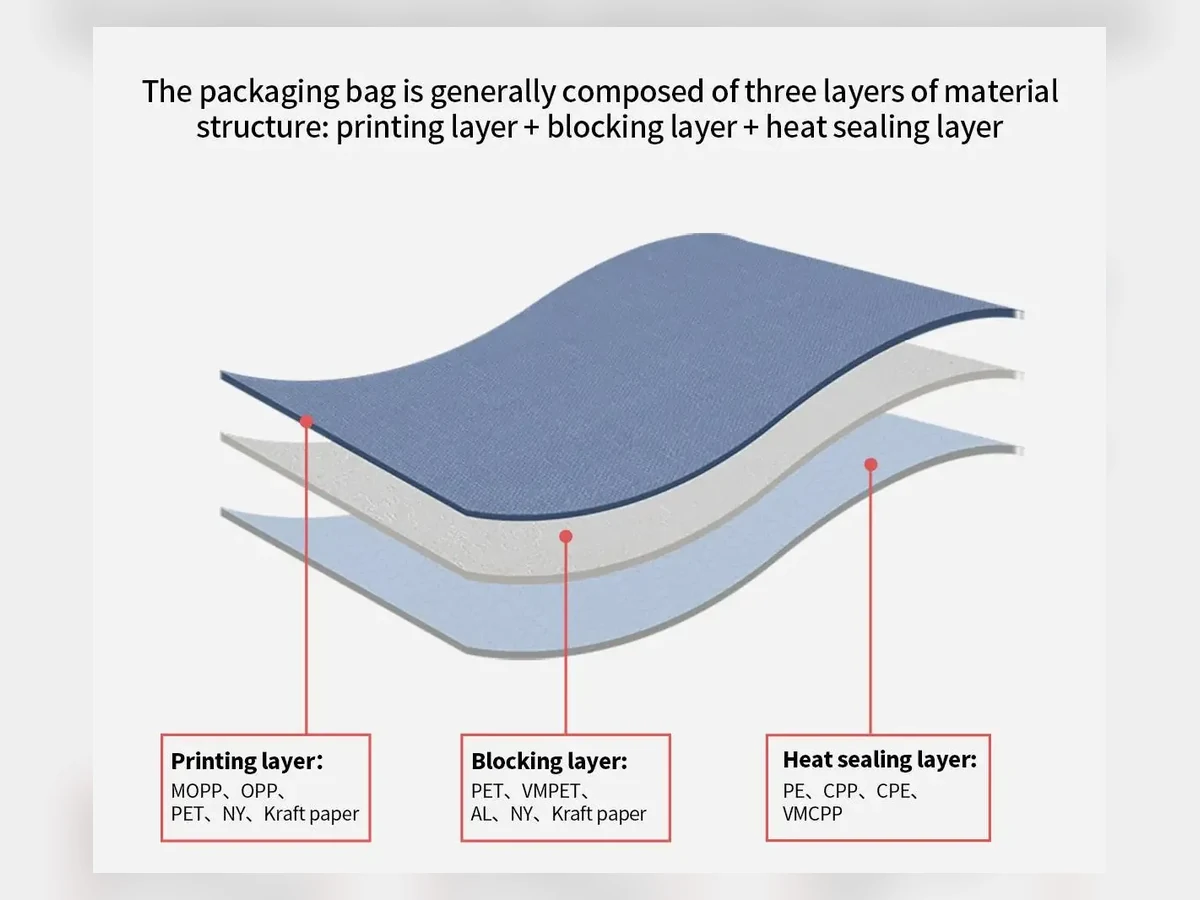
| Seal layer | PE 30–100 μm, or CPP 25–70 μm | Drives seal strength and machine settings |
| Roll weight | 15–25 kg typical | Manual handling limit on many lines |
Repeat length is not a design choice
Repeat length is fixed by the print cylinder, so it has to be decided before artwork is finalised. If your design is 220 mm tall and the available cylinder repeats are 200 mm and 250 mm, the artwork gets stretched or you pay for a new cylinder. Ask for the available repeats first, then design to one of them, leaving 3–5 mm of dead space at the seal area.
Structures and barrier
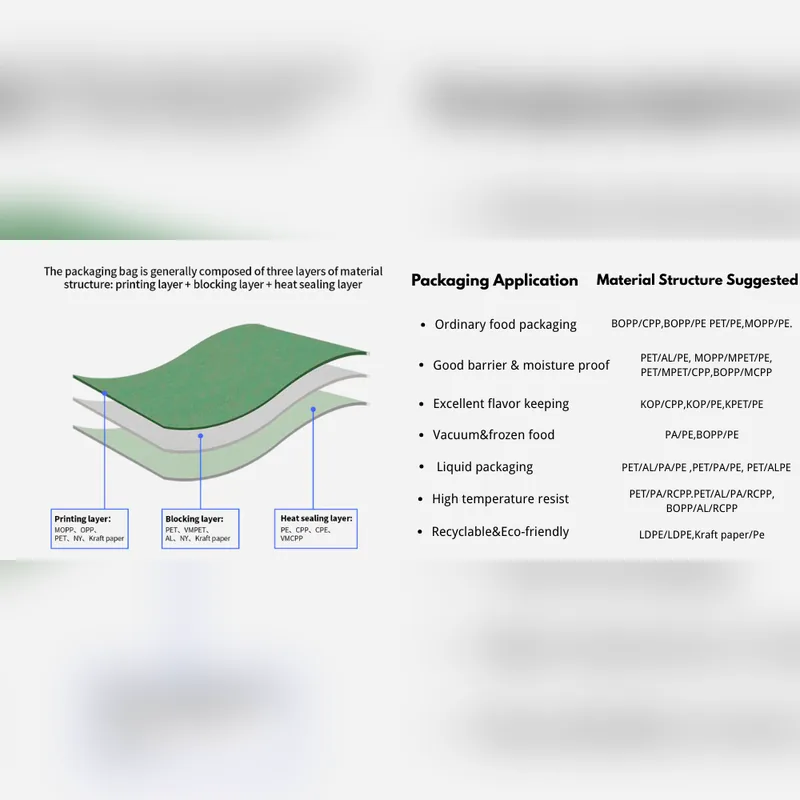
The structure follows the product. PET/PE covers dry snacks and requires a moderate moisture barrier. PET/AL/PE adds an aluminium layer for coffee, powdered drinks and anything sensitive to oxygen and light. MATT BOPP/AL/PE gives a premium matte finish with high barrier. Metallised BOPP/PE sits between: better than clear film, cheaper than foil.
Ask for the moisture vapour transmission rate (MVTR) and oxygen transmission rate (OTR) of the exact structure you are buying, measured at the conditions your product will see. A number quoted for a different structure is marketing, not a specification.
Surface treatment and print quality
Films need a dyne level of at least 38 for solvent-based inks and 40 or above for some water-based systems, or the ink will not anchor. Treatment decays with time, especially on PE surfaces, so film that has sat in a warehouse for six months may print poorly even though it was treated at production. Order print-ready film against a production date, not from old stock.
What to put on the purchase order
• Structure with layer order and grammage per layer, for example PET 12 / AL 7 / PE 80.
• Width, core ID, roll OD, roll weight and the direction of unwind.
• Repeat length in mm, plus the artwork code and the approved proof version.
• Seal strength target and the test method your QA uses.
• Shelf life expectation for the finished pack, so the barrier is chosen against a target rather than a habit.
Frequently asked questions
What is the MOQ for printed roll film?
Typically 100–300 kg per design, depending on width and structure. Below that, digital printing on shorter runs may be possible but the cost per kilogram rises.
Can I use the same film on two different machines?
Only if width, core, repeat and seal layer all match. Two VFFS lines from different makers often need different film widths and sometimes different seal layers.
Does the film need to be food-grade?
For direct food contact, yes: the structure and the adhesive must comply with the food-contact rules of your market, and the supplier should provide the declaration and migration data.
How long does a printed roll order take?
Usually 15–25 days after artwork approval for gravure, plus transit. New cylinders add about a week.
Send us your bag drawing and machine model, and we will confirm the film width, core and repeat before you approve artwork.
Related reading
• Custom aluminium film roll for food and coffee
• PET/ALU/PE laminating film roll