
Pet Food Packaging Documents: What to Request From a Bag Supplier
November 23, 2026
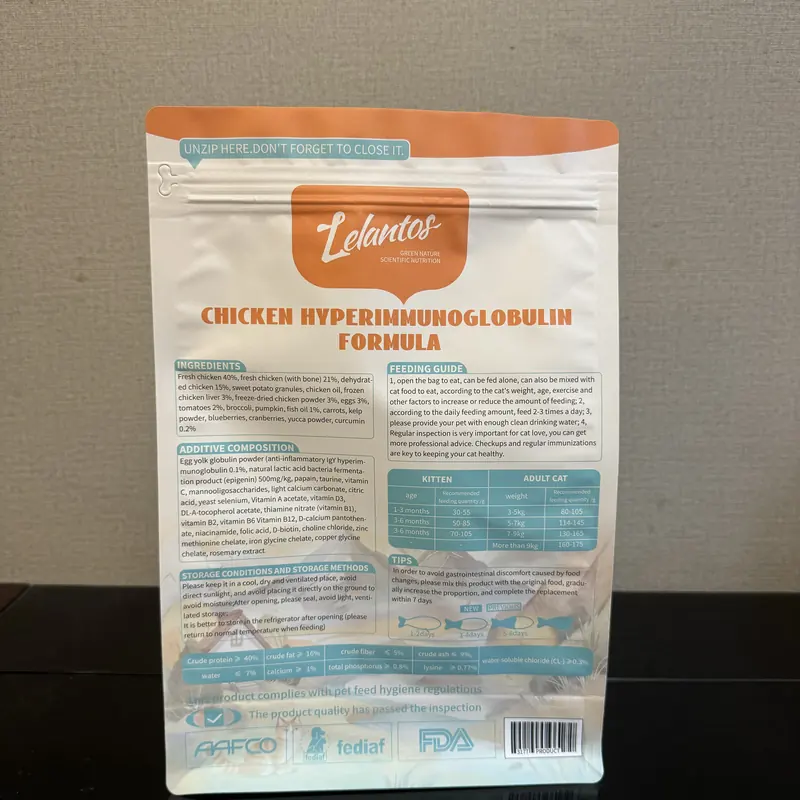
Before a pet food bag order ships, ask for five documents: a declaration of compliance for the food-contact layers, a migration test report, a GMP or hygiene statement for the converting site, an ink and adhesive statement, and the full layer specification with thicknesses. If any of those is missing, you cannot answer a retailer's technical questionnaire, and you cannot defend the pack if a customer complains.
Pet food is legally feed rather than food in most markets, and the framework differs: EU feed hygiene rules, US food-contact rules that most buyers apply voluntarily, and GB 4806 in China for food-contact materials. Ask the buyer which framework their market requires, then request documents against that framework rather than a generic certificate.
The five documents and what each one proves
| Document | What it proves | What to check |
|---|---|---|
| Declaration of compliance | The materials meet the food-contact framework named on it | Framework and regulation number, issue date, signatory |
| Migration test report | Overall and specific migration are within limits | Test conditions match your use: fatty food, hot fill or retort |
| GMP or hygiene statement | The converting site runs a documented hygiene system | Scope covers printing, lamination and pouch making |
| Ink and adhesive statement | Inks and adhesives are suitable for food-contact use | Low-migration ink, solvent residue limits |
| Layer specification | Exactly what the bag is made of | Layer order, thickness in microns, sealant grade |
Why the test conditions matter more than the certificate
A migration report is only valid for the conditions it was run under. A bag tested for 10 days at 40 degrees does not cover a retort pouch processed at 121 degrees, and a report using the aqueous simulant does not cover a fatty product like a meat-based kibble. Match the simulant and the time and temperature to the real use, or the document is decoration.
| Product type | Relevant simulant | Typical test condition |
|---|---|---|
| Dry kibble | Tenax or 95% ethanol for dry fatty food | 10 days at 60°C or per the framework |
| Treats with surface fat | Vegetable oil | 2 hours at 70°C, then 10 days at 40°C |
| Wet food, retort | Fat simulant plus aqueous | 2 hours at 121°C |
| Semi-moist | Aqueous and fatty, combined | 4 hours at 100°C |
Certificates you will see and what they mean
ISO 9001 covers quality management, ISO 22000 or FSSC 22000 covers food safety management, and BRCGS Packaging Materials is the audit most European retailers recognise. FDA registration is a site registration, not a product approval. None of these replace a declaration of compliance for the specific materials in your bag, and a supplier who offers only a certificate logo without the layer specification is not giving you what an auditor will ask for.
Label fields the printer needs from you
The printer prints what you approve, and the legal content of the label sits with the brand. Supply the finished artwork with the fields below already resolved, because a missing lot code area or a barcode that cannot be scanned at the specified size means a new plate.
• Net weight and, where required, the drained weight for wet products.
• Best before or expiry field, with space for a lot or batch code applied at filling.
• Species and life stage, as required by the destination market.
• Analytical constituents and composition, supplied by your nutritionist.
• Business name and address of the responsible operator.
• Barcode at the correct magnification with a clear quiet zone.
• Material and recycling marks that match the actual structure.
Frequently asked questions
Do I need a food-grade certificate for a pet food bag?
You need a declaration of compliance and a migration report for the materials, not a generic certificate. Retail buyers increasingly ask for both, and the declaration must name the regulation it was issued against.
Is a pet food bag a food-contact material?
In most markets the packaging must still not transfer harmful substances into the feed, and buyers usually apply food-contact standards even where the law treats pet food as feed. Confirm the requirement for your destination before ordering.
How often should documents be renewed?
Annually in practice, or whenever the structure, the ink system or the converting site changes. Keep the version on file with the date, because an auditor will ask which revision was in force when the batch was made.
Can you supply the documents before I place an order?
We can supply the layer specification, the material declarations and the site certificates for the proposed structure before an order, and the batch-specific report with the shipment. Final artwork review stays with your regulatory contact.
Send the destination market and the product type, and we will list the documents your buyer will ask for and the test conditions that match your filling process.
Related reading
• Food grade flexible pet food packaging guide
• Retort aluminium foil wet cat food pouch, 121°C